PTF Impacts
Provost's Teaching Fellows have made lasting impacts in their departments, colleges and schools, all of the University of Texas, and even the broader scholarship of teaching and learning. Through both individual initiatives and university-wide programs, PTFs continue to serve as catalysts for positive change and further our campus culture of teaching and learning.
Displaying 1 - 14 of 14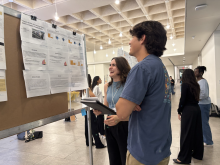
Applications of Data Science with City Datasets: Poster Session at UT Austin
On April 30, 2025, Guyot hosted a public poster session showcasing student projects focusing on datasets from the City of Austin Open Data Portal, held at the University of Texas at Austin. Projects ranged widely in focus, from environmental data to transportation and public safety, demonstrating the breadth of student inquiry and analysis.
Teaching Tips 2024-2025
Each year, the PTF Chair-Elect has the opportunity to share recurring Teaching Tips with the all faculty at UT.
Teaching Tips 2023-2024
Each year, the PTF Chair-Elect has the opportunity to share recurring Teaching Tips with the all faculty at UT. These messages cover a variety of topics, styles, and methodologies, from brief and practical classroom strategies to in-depth conversations with voices from across campus.

Digital Research Apprenticeship: Student Research and Artifacts
In 2024, many of Dr. Tanya Clement's student researchers created dynamic Digital Humanities projects, and some were able to share those projects with broader academic audiences:
Trent Wintermeier (graduate student), Monica Olivio, and Nati Roman (undergraduates) presented “Listening and Annotating Spirituality in the Gloria Anzaldúa Archive” as part of Platforms, Power, and Pedagogy. Computers and Writing Conference. Texas Christian University, Fort Worth, Texas, in June 2024.
Team-Based Learning in the Political Science Classroom (Journal of Political Science Education)
Former PTF chair Stephanie Holmsten published this article in the Journal of Political Science Education in September 2023, which is partially informed by findings and experiences from her PTF initiative.
Find the complete article here, or read a summary below.

Objective Structured Clinical Examination (OSCE) Performance Assessment of PharmD Student Pharmacists (AACP)
Dr. Acosta, Dr. Castleberry, and colleagues presented a poster at the July 2023 Meeting of the American Association of Colleges of Pharmacy in Aurora, Colorado. Their poster discussed the relationships between a student’s perceived preparedness before and after Objective Structured Clinical Examinations (OSCEs), OSCE grades, perception of their performance, pre-pharmacy and pharmacy GPAs, composite Pharmacy College Admission Test (PCAT) score, and admission Multiple Mini Interview (MMI) scores.
Teaching Tips 2022-2023
Each year, the PTF Chair-Elect has the opportunity to share recurring Teaching Tips with all faculty at UT. These messages cover a variety of topics, styles, and methodologies, from brief and practical classroom strategies to in-depth conversations with voices from across campus.
This year’s Teaching Tips were written by Chair-Elect Nina Telang, from the Chandra Department of Electrical and Computer Engineering.

ClioVis: Visualizing Connections (Review, Journal of American History)
Dr. Jason Heppler of George Mason University reviewed ClioVis, the digital timeline visualization tool developed by Erika Bsumek, in the March 2024 issue of the Journal of American History. According to an excerpt from the review:
Bearing and Sharing the Burdens of Mentoring in the COVID-19 Pandemic (TAPA)
PTF alum Deborah Beck authored this invited paper as part of a group of six articles on "rupture and repair" in the wake of the COVID-19 pandemic, which was published in Transactions of the American Philological Association, the journal of the professional organization for American Classicists. In the article, she explores the impacts of the COVID-19 pandemic's social isolation and "New Normal" on faculty peer mentorship and how the landscape of academic mentorship has changed since the onset of the pandemic.
Teaching Tips 2021-2022
Each year, the PTF Chair-Elect has the opportunity to share recurring Teaching Tips with all faculty at UT. These messages cover a variety of topics, styles, and methodologies, from brief and practical classroom strategies to in-depth conversations with voices from across campus.
This year’s Teaching Tips were written by Chair-Elect Jessica Toste, from the Department of Special Education.
Teaching Tips 2020-2021
Each year, the PTF Chair-Elect has the opportunity to share recurring Teaching Tips with all faculty at UT. These messages cover a variety of topics, styles, and methodologies, from brief and practical classroom strategies to in-depth conversations with voices from across campus.
This year’s Teaching Tips were written by Chair-Elect Stephanie Seidel Holmsten, from the International Relations and Global Studies program.

Integrating an Architectural Engineering Undergraduate Program with Building Information Modeling (Journal of Architectural Engineering)
PTF Fernanda Leite co-authored this article in the Journal of Architectural Engineering. The article examines the integration of Building Information Modeling (BIM) into an undergraduate Architectural Engineering course, which was a core component of Leite's PTF Initiative.
Read the complete paper here, or find the abstract below.
Teaching Tips 2019-2020
Each year, the PTF Chair-Elect has the opportunity to share recurring Teaching Tips with all faculty at UT. These messages cover a variety of topics, styles, and methodologies, from brief and practical classroom strategies to in-depth conversations with voices from across campus.

ClioVis Digital Timelines: Visualizing Connections
Erika Bsumek built the ClioVis digital timelines platform for instructors and students to build interactive digital timelines as part of their coursework or scholarly initiatives. The platform has been used by thousands of students across the US, including throughout the UT System, University of Michigan, Stanford, and others, in both humanities and STEM disciplines, as well as for research initiatives.