PTF Impacts
Provost's Teaching Fellows have made lasting impacts in their departments, colleges and schools, all of the University of Texas, and even the broader scholarship of teaching and learning. Through both individual initiatives and university-wide programs, PTFs continue to serve as catalysts for positive change and further our campus culture of teaching and learning.
Displaying 1 - 14 of 14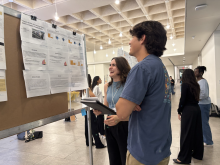
Applications of Data Science with City Datasets: Poster Session at UT Austin
On April 30, 2025, Guyot hosted a public poster session showcasing student projects focusing on datasets from the City of Austin Open Data Portal, held at the University of Texas at Austin. Projects ranged widely in focus, from environmental data to transportation and public safety, demonstrating the breadth of student inquiry and analysis.

Additional Grant Funding (Cockrell School of Engineering)
Alongside Dr. Berkin Dortdivanlioglu, PTF Krishna Kumar received a grant from the Cockrell School of Engineering to use AI for personalized tutors in their introduction to programming course. They have since built a personalized tutor for this course, which is available for students privately. They are now in the process of making the tutor public through the Texas Advanced Computing Center (TACC).

Digital Research Apprenticeship: Student Research and Artifacts
In 2024, many of Dr. Tanya Clement's student researchers created dynamic Digital Humanities projects, and some were able to share those projects with broader academic audiences:
Trent Wintermeier (graduate student), Monica Olivio, and Nati Roman (undergraduates) presented “Listening and Annotating Spirituality in the Gloria Anzaldúa Archive” as part of Platforms, Power, and Pedagogy. Computers and Writing Conference. Texas Christian University, Fort Worth, Texas, in June 2024.

New Doctor of Nursing Practice Program
Starting with her Initiative from the inaugural PTF cohort, PTF Emeritus Carol Delville worked with School of Nursing colleagues to transition the Advanced Practice program in Adult Gerontology into a Doctor of Nursing Practice (DNP) degree program. Delville describes the transition as making her "legacy dream come true," and says about her time in the PTF program, "I think [it was] one of the greatest opportunities UT has offered me."

Additional Initiative Funding (COLA)
PTF Julia Mickenberg worked with her Graduate Assistant and collaborator, Ricky Shear (Department of English), on a survey of UT liberal arts alumni aiming to find out what alumni valued about their liberal arts degrees and how they felt those degrees limited them. The College of Liberal Arts provided Mickenberg with additional funding in order to broaden the scope of the survey from department-specific alumni to the entire College.

Supplemental Instruction (SI) Program for Electrical and Computer Engineering
For her Provost's Teaching Fellows initiative, Nina Telang developed of a Supplemental Instruction (SI) program in a sophomore-level Electrical and Computer Engineering course, EE319K: Introduction to Embedded Systems.
Supplemental Instruction (SI) study sessions to help students succeed in introductory courses by employing a peer teaching model. SI Leaders – TAs or peers who have already successfully taken the course – plan and lead two identical, voluntary SI sessions each week, which students can join at any point in the semester.

National Science Foundation Grant
PTF Vernita Gordon was awarded a National Science Foundation Grant on April 1, 2022 as principal investigator. The research objective of the grant is to develop a predictive framework for understanding how bacteria use proteins in their cell envelopes to sense and respond to the mechanics of the surface to which they attach.

ClioVis: Kendra Scott WEL Female Founder Competition Semi-Finalist and Crowd Choice Winner
The Kendra Scott Women's Entrepreneurial Leadership Institute (KS WELI) held the inaugural Female Founder Pitch Competition in October 2021.

Critical Literacies Project: ClioVis (UT System P20 Projects)
The UT System works with internal and external partners to foster critical literacies in students across the P20 continuum. UT institutions work to cultivate these literacies in students across traditional and emerging academic disciplines, and through partnerships and programs in PK12 schools, communities, and business and industry across Texas.

ClioVis Digital Timelines: Visualizing Connections
Erika Bsumek built the ClioVis digital timelines platform for instructors and students to build interactive digital timelines as part of their coursework or scholarly initiatives. The platform has been used by thousands of students across the US, including throughout the UT System, University of Michigan, Stanford, and others, in both humanities and STEM disciplines, as well as for research initiatives.

Standardized elements for OCSE
Objective Structured Clinical Examinations, known as OSCEs, are a widely established assessment practice in Pharmacy education. PTF Renee Acosta created OSCE rubrics as part of her PTF initiative to help students gain constructive feedback and more consistent practice of their skills prior to moving on to future courses. Acosta's rubrics that have since been used as the foundation for future PTF projects and other OSCE rubrics used within department.
View the rubrics here.

Entrepreneurship Minor, McCombs School of Business
As part of his PTF Initiative, Luis Martins founded the Entrepreneurship Minor within the McCombs School's Rosenthal Department of Management. The Entrepreneurship Minor is available to all undergraduate students at UT Austin, and develops entrepreneurial mindsets and skillsets that equip students to have impact on organizations and society as startup founders or as employees in established organizations.
Drama-based Pedagogy Interdisciplinary Faculty Learning Community
PTF Katie Dawson coordinated a Faculty Learning Community of six faculty members from across UT - American Studies, Biology, Art/Design, Classics, Education, and Theatre- in a 15 week faculty learning community focused on active and creative teaching strategies. Through the project, faculty members explored active and creative teaching methods in monthly meetings, and re-designed at least two lectures to use active/creative teaching approaches. Faculty also received individual coaching and observation from me or one of my graduate students.

Health Communications Scholars Program
Launched in 2013, the Health Communication Scholars Program (HCSP) seeks to support graduate student research in health communication. HCSP was created by Dr. Mike Mackert within the Moody College of Communication and initially funded by the Provost’s Teaching Fellows program.