PTF Impacts
Provost's Teaching Fellows have made lasting impacts in their departments, colleges and schools, all of the University of Texas, and even the broader scholarship of teaching and learning. Through both individual initiatives and university-wide programs, PTFs continue to serve as catalysts for positive change and further our campus culture of teaching and learning.
Displaying 1 - 9 of 9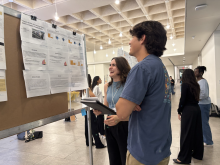
Applications of Data Science with City Datasets: Poster Session at UT Austin
On April 30, 2025, Guyot hosted a public poster session showcasing student projects focusing on datasets from the City of Austin Open Data Portal, held at the University of Texas at Austin. Projects ranged widely in focus, from environmental data to transportation and public safety, demonstrating the breadth of student inquiry and analysis.

Faculty Statistics Seminar (Texas State University)
PTF Layla Guyot gave an invited presentation at the weekly statistics seminar at Texas State University, to an audience of primarily faculty. In her talk Guyot discussed promoting the use of a local open data portal for data science projects.

Teaching as Well Being (UT System)
On April 11, 2024, three Provost's Teaching Fellows presented at the final session of the "Teaching as Wellbeing" mini-conference series, hosted by the UT System Academy of Distinguished Teachers in collaboration with UT System faculty developers. The series served as a monthly think tank about the relationship between teaching, learning, and wellbeing for educators and educational developers across UT system.

Promoting the use of open data for data science projects (Open Data Day)
PTF Layla Guyot presented a session at Open Data Day in March 2024, hosted by the Austin Public Library. This event was part of International Open Data Day, which celebrates open government data with events hosted around the globe. Guyot presented about promoting the use of a local open data portal for data science projects with her collaborator, former student/current UGCA Dustyn Ransom.

City of Austin DIVE Meetup
Nine students from PTF Layla Guyot's Elements of Data Science course were selected to virtually present the insights gained during their coursework to the Data, Impact, Visuals, and Exploration (DIVE) meetup organized by the City of Austin.

Critical Literacies Project: ClioVis (UT System P20 Projects)
The UT System works with internal and external partners to foster critical literacies in students across the P20 continuum. UT institutions work to cultivate these literacies in students across traditional and emerging academic disciplines, and through partnerships and programs in PK12 schools, communities, and business and industry across Texas.

Drivers Exercise
Before deciding what your career goals are, it’s critical to know what you value most in a job. What gets you out of bed to go to start the day, go to work, and/or live your life? This exercise will help you define and prioritize what drives you. We provide definitions of 8 common "drivers". Once you understand these drivers, you can take the exercise and go through a ranking process to determine which are most important to you (i.e. you’re less likely to compromise on these) and which are less important (i.e. you’re more willing to compromise on these).

ClioVis Digital Timelines: Visualizing Connections
Erika Bsumek built the ClioVis digital timelines platform for instructors and students to build interactive digital timelines as part of their coursework or scholarly initiatives. The platform has been used by thousands of students across the US, including throughout the UT System, University of Michigan, Stanford, and others, in both humanities and STEM disciplines, as well as for research initiatives.

FromthePage, Crowdsourced Digital Archiving (UT Libraries Instance)
As part of his PTF Initiative, Adam Rabinowitz developed two UT resources for crowd-sourcing humanities archival and historical work and student “citizen science:" FromthePage (partnered with UT Libraries) and Nanosourcer (a Canvas plugin). UT’s customized FromthePage instance is permanently supported by UT Libraries, publicly available, and has nearly 1000 users working on over a dozen different archival collections.